Author Archives: PSMN®

USPTO Posts Questionable Advice for People Who Receive Demand Letters

by: Robert Wagner, intellectual property attorney at Picadio Sneath Miller & Norton, P.C. ()

Last week, the US Patent and Trademark Office expanded its website to include a section to help individuals and companies to respond when receiving demand letters from patent holders. As one of our colleagues, Gene Quinn, over at IPWatchdog.com notes, this resource (albeit in “Beta” form) is fairly one-sided and offers some problematic advice to those who receive demand letters.USPTO

Much of the advice on the USPTO’s website is fairly generic, but the overall tenor of the advice seems to ignore that legitimate patent owners with legitimate and valid patents often send these demand letters to stop individuals and companies from infringing their patents. Indeed, that is one of the fundamental rights that comes with owning a patent—the ability to stop others from using your invention.

Instead, the fundamental assumption on the USPTO’s website seems to be that only patent trolls send demand letters. For instance, the USPTO suggests that one response is to simply ignore a demand letter because some patent owners send these demand letters to mislead or intimidate the recipients into paying for licenses that they do not need. While the USPTO notes that this approach carries some risk, that advice is buried at the end. Oddly, the USPTO never suggests that one option after receiving a demand letter is to simply stop infringing the patent.

The USPTO also downplays the importance of consulting with an attorney to help understand the risks and to respond to the patent owner in an appropriate manner. Patent law is not a simple subject, and most individuals simply do not have the expertise or knowledge to determine whether they are infringing, whether the patent is valid and enforceable, and what the risks may actually be.

In my years of practice, I have noticed that many individuals do not understand what the scope of a patent is unless they have significant prior experience with patents. They tend to look at the description of the invention in the specification or the drawings, rather than the claims, when trying to assess their exposure. As patent practitioners know, it is the claims that truly matter (although the specification is important to understanding those claims), and those claims are often far broader then the particular embodiments disclosed in the specification. In addition, claims are not written in a format that is simple to understand, or there are statements made during the prosecution of the patent that are important to understanding their scope, which compounds the problem. Thus, there is a very real risk that individuals will drastically underestimate the risk that they infringe unless they receive competent legal advice.

While hiring an attorney may be an expensive proposition, the consequences of not doing so may be far greater. A typical patent infringement lawsuit can easily cost more than $500,000 to defend, even where the amount at issue is small (and can cost tens of millions of dollars when significant amounts are at issue). And, once a lawsuit begins, it can be very hard for a defendant to unilaterally stop it. If an individual is truly infringing, an attorney can help the client understand the risks and suggest ways of resolving the matter before litigation begins, which potentially can save an individual hundreds of thousands of dollars. Simply ignoring a demand letter can be the last thing an accused infringer should do unless there is a very good reason for doing so because ignoring the demand letter starts to lay the groundwork for a finding of willful infringement, which potentially entitles the patent owner to triple damages and an award of its attorneys’ fees and costs.

The problem of extortionate patent trolls is very real, and I have represented numerous companies that have been the targets of these kinds of trolls. It is extremely frustrating to explain to a client the financial costs and distractions that come with defending a meritless lawsuit brought by patent troll and the fact that there often is no simple way to make the lawsuit disappear without paying some amount of money to the troll. That being said, I’ve also represented legitimate companies with patents on innovations they developed that help give them a competitive edge in the marketplace. They have spent significant time and resources in developing these innovations and bringing them to market and understandably want to protect those investments. The USPTO’s blanket advice to individuals and companies that might receive a demand letter is not particularly helpful and understates the real risks and costs that are at issue. It is somewhat disturbing that an office that is charged with issuing valid patents and supporting innovation would put out such incomplete and unbalanced advice. Hopefully, the USPTO will present more balanced and useful advice when this website moves out of its “beta” stage.

Significant Interest in Alice Corp. v. CLS Bank Int’l Case at Supreme Court

by: Robert Wagner, intellectual property attorney at Picadio Sneath Miller & Norton, P.C. ()

SupremeCourtImage_1The Supreme Court granted certiorari in Alice Corp. Pty. Ltd. v. CLS Bank International, (No. 13-298), to address the boundaries of what constitutes patent eligible subject matter under 35 U.S.C. § 101 and, more specifically, whether and to what extent software is patent eligible. We’ve been following this case since it was at the Federal Circuit (see our prior post here) and noted the chaos that emerged from the Federal Circuit’s en banc decision that could not decide on the proper standards for software patent eligibility.

Since Alice Corp. filed its petition for a writ of certiorari, 34 amicus briefs have been filed, indicating the importance of this case to the patent community. (To read the briefs, click here). The briefs have been circulated to the justices, and oral argument is scheduled for March 31, 2014.

As numerous commentator’s have pointed out (see, e.g., here), software has been patent-eligible subject matter for almost 50 years and accounts for a significant number of granted patents. A decision by the Supreme Court that software is not patent eligible would have huge repercussions throughout the patent and software worlds. We will be monitoring the case and will report on the oral argument, once it occurs.

Pennsylvania Senate to Consider Patent Troll Bill

by: Robert Wagner, intellectual property attorney at Picadio Sneath Miller & Norton, P.C. ()

In the continuing quest to limit or prevent patent “trolls” from filing frivolous lawsuits against alleged infringers, state legislatures are jumping into the mix and proposing state laws to discourage or prohibit this kind of conduct. Pennsylvania is among the latest to join this bandwagon. PA Senate Bill No. 1222, introduced on February 4, 2014 is an effort to limit and discourage frivolous patent infringement lawsuits. However, given the scope of the bill, and the potential conflicts with federal law, there are serious questions as to both the wisdom of the approach it takes and whether this bill will ever become law.

The Language of the Bill

Bill No. 1222 purports to prohibit bad faith assertions of patent infringement. (Section 3(a)). It allows a target of a demand letter, someone threatened with patent infringement, or a defendant in a patent infringement lawsuit to bring an action in state court (the court of common pleas) for bad faith. (Section 5(b)). If the court determines that there is a reasonable likelihood that the patentee has threatened or is litigating a patent infringement claim in bad faith, the court can require the patentee to post a bond to cover the target’s legal costs and damages, but not to exceed $250,000. (Section 4). In addition, among the possible remedies are equitable relief, damages, costs and fees, and exemplary damages of $50,000 or three times the total damages, costs, and fees, whichever is greater. (Section 5(b)).

Under the bill, the following factors may be considered as evidence that a patentee is bringing a bad faith claim of patent infringement (Section 3(b)):

  • When a demand letter fails to contain the patent number, the identity of the patent owner, or factual allegations of why the target infringes.
  • When the patentee conducted adequate due diligence before sending the demand letter.
  • When the patentee refuses to provide certain information to the target when requested to do so.
  • When the demand letter demands a response or payment within an unreasonably short period of time.
  • When the license demand is not reasonably related to what the license should be worth.
  • When the patentee knew the claim was meritless or deceptive.
  • When the patentee previously filed or threatened similar actions that were meritless or failed to disclose the kinds of information identified above.

In contrast, the following factors may be considered as evidence that the patentee is not bringing a bad faith claim of patent infringement (Section 3(c)):

  • When a demand letter includes the patent number, the identity of the patent owner, and factual allegations of why the target infringes, or the patentee provides this information on request.
  • When the patentee engages in a good faith effort to establish infringement and negotiate an appropriate remedy.
  • When the patentee has made a substantial investment in using the patent or selling products that use the patent.
  • When the patentee is the inventor, joint inventor, original assignee, or an institution of higher education (or its tech transfer office).
  • When the patentee has demonstrated successfully enforced the patent in litigation or has in good faith previously tried to enforce the patent.

Thoughts About the Merit of This Bill

Determinations of whether a patent infringement claim has been brought in good or bad faith will necessarily require a significant analysis of the underlying merits of the claim, including claim construction and the intricacies of infringement and invalidity issues. State courts have never had to deal with these issues before because federal courts have exclusive jurisdiction under 28 U.S.C. § 1338(a) to hear all patent cases. Thus, this bill would place state courts in uncharted and complex waters that they have never had to deal with.

In addition, this bill purports to extend not just to demand letters sent by patentees, but also filed patent infringement lawsuits (which must be in federal court). It is unclear how state courts are to be addressing issues being litigated in federal court and what power a state court has to interfere with those parallel proceedings. One would think that a federal court that is handling the lawsuit is in a far better position to assess the good or bad faith of a patentee’s claims.

While it is a laudable goal to create disincentives to filing frivolous lawsuits, this bill seems particularly ill suited to this goal. We will be following this bill as it progresses, and will report on its progress.

Penn State Sues Samsung for Patent Infringement by Galaxy Smartphones

by: Robert Wagner, intellectual property attorney at Picadio Sneath Miller & Norton, P.C. ()

psu_logoIt’s not just Apple that is suing Samsung in the smart phone arena. Last Friday, the Penn State Research Foundation (the technology transfer office for Penn State) sued Samsung in the United States District Court for the Middle District of Pennsylvania, Case No. 4:14-cv-00124, for allegedly infringing the Foundation’s US Patent No. 6,720,572, entitled “Organic Light Emitters with Improved Carrier Injection.”

Galaxy S4In the complaint, the Foundation contends that at least Samsung’s Galaxy SIII and Galaxy S4 products infringe the ‘572 Patent. The Foundation also contends that Samsung willfully infringed the ‘572 Patent because it knew of the patent at least as early as May 12, 2010, when it was referenced by the USPTO in a office action involving one of Samsung’s patent applications.

The ‘572 Patent relates to:

A light emitting device with improved carrier injection. The device has a layer of organic light emitting material and a layer of organic semiconductor material that are interposed between first and second contact layers. A carrier transport layer, may optionally be included between the semiconductor and light emitting layers. When used as a diode, the first and second contacts are functionally the anode and cathode. The device can also be a field effect transistor device by adding a gate contact and a gate dielectric. The first and second contacts then additionally have the function of source and drain, depending on whether the organic semiconductor material is a p-type or an n-type. Preferably, the organic semiconductor is formed with pentacene.

As the case was just filed, there has been little activity in it. We will monitor this case as it progresses.

Federal Circuit Grants Additional Time to Term of Patent from Continued Examination

by: Robert Wagner, intellectual property attorney at Picadio Sneath Miller & Norton, P.C. ()

USPTOIn an opinion issued Novartis AG v. Lee (No. 2013-1160, -1179) yesterday, the Federal Circuit clarified the standards for how much additional time the USPTO should add to the term of an issued patent under 35 U.S.C. § 154(b) when a patentee requests a continued examination.

When Congress changed the effective term of a patent from 17 years after issuance to 20 years after filing, it provided that extensions would be granted in certain circumstances where the delay in issuing the patent was due to the USPTO’s actions or inactions. The rules governing this extension are set forth in 35 U.S.C. § 154. In general, the term of a patent will be extended by one day for each day after three years of examination (subject to some exclusions), or when there are delays due to an interference, secrecy order, or successful appeal.

At issue in this appeal was the proper application of the provisions of 35 U.S.C. § 154(b)(1)(B)(i), which exclude “any time consumed by continued examination of the application requested by the applicant under section 132(b).” With respect to two patents, Novartis requested continue examination under § 132(b). The USPTO Director refused to grant any extensions for the time from the request until issuance of the patents.

Novartis first argued that § 154(b)(1)(B)(i) does not apply if the request for continued examination occurs more than three years after the filing of the application. The Federal Circuit rejected this argument because the purpose of the statute and the other aspects of the statutory structure did not support it. The Court did acknowledge that the language was unclear, but ultimately concluded that Novartis’s position was incorrect.

Novartis next argued that the § 154(b)(1)(B)(i) exclusion only applies to the time from the request to the notice of allowance (not to the date of issuance). The Federal Circuit agreed. The allowance to issuance time period is not related to the continued examination and involves time spent in the office of publication, not with the examiner. The Court felt it inappropriate to not credit the patentee with any delays caused during that part of the process. To the extent that there are any unusual delays relating to the examination after allowance, the USPTO can make appropriate adjustments where appropriate.

While this decision is not likely to affect many patents, practitioners should be aware of this change in these circumstances to make sure that the USPTO is properly calculating any extensions that are due to the patentee.


Federal Circuit Affirms Rejection by Examiner Based on Incomplete Prior Art

by: Robert Wagner, intellectual property attorney at Picadio Sneath Miller & Norton, P.C. ()

Federal CircuitThe Federal Circuit issued an interesting decision in In re Enhanced Security Research, LLC (No. 2013-1114) this week. The Patent Trial and Appeal Board (PTAB) affirmed an examiner’s rejection of certain claims of a patent as obvious during an ex parte reexamination based on a user manual that was missing pages and of dubious origins. The Federal Circuit, in a 2-1 decision, affirmed. What makes this case interesting is the discussion of the completeness and authenticity of the prior art considered by the Patent Office.

Background

Enhanced Security Research (“ESR”) obtained a patent for “a computer security device and method for preventing unauthorized individuals from gaining access to a local computer network.” A third party who was in litigation with ESR requested reexamination based on two pieces of prior art—a user manual to a piece of software called NetStalker and a scholarly article. The use of the manual is at the heart of the issues in this case.

ESR challenged the propriety of the examiner relying on the manual based on the fact that pages were missing, it was not clear that this particular exemplar was available to the public, and it was not clear whether the manual was a draft. The third party requester provided an affidavit from the CEO of the company that produced the software attesting to its completeness (even though pages were clearly missing) and that it was a version available to the public. The CEO was not an uninterested party, however, as he was a paid expert for the third party requester in litigation against ESR.

The examiner, relying on a page from the manual, concluded that certain claims were obvious. Interestingly, many of the missing pages came from the same chapter as the page relied on by the examiner, including the pages immediately before and after that page.

The Majority Affirms

The majority of the Federal Circuit panel affirmed the decision of the examiner and PTAB that found that the information contained in the manual, when combined with the scholarly article, rendered certain claims of the patent obvious. The majority then went on to consider whether the examiner and PTAB should have relied on the manual as prior art.

They ultimately concluded that the manual was prior art. First, they noted that the standard of what is sufficiently “available to the public” for purposes of 35 U.S.C. § 102(a)(1) is a question of law based on underlying facts. Availability does not have to mean widely available—“a single cataloged thesis in one university library” is sufficient. The Court found that there was sufficient basis to believe that the manual was available to the public in the relevant time period based on a date in the manual and the declaration of the CEO.

Next, they found that the missing pages did not disqualify the reference. Only the relevant portions of a piece of prior art need be provided to an examiner, citing 37 C.F.R. §1.510 and MPEP § 704.14(a) ¶ 7.122. The Court did note that there may be instances where the absence of key pages would disqualify a reference, such as where it is believed that those pages would be necessary to understand the reference, but that circumstance did not exist here.

The Dissent Disagrees

One of the Judges strongly disagreed with the majority’s holding. In particular, she was troubled by the circumstances present with the manual and the declaration of the CEO.

First, the CEO was not a disinterested party. He was a paid expert for the third-party requester who was also in litigation against ESR. This raised credibility concerns, especially when portions of the manual in question, including the pages immediately before and after one of the pages relied on by the examiner, were missing. She was also troubled by his declaration that the manual was “a true and correct copy” when it clearly was not.

In addition, the dissent was troubled by the declarant’s failure to particularly state that the NetStalker product was sold prior to the critical date or that this particular manual was ever provided to any customers prior to the critical date.

Finally, the dissent was concerned that the manual was only a draft, because it bore a cryptic legend on its cover, there were question marks in the index, and the last ten pages of the final chapter did not exist. She believed that there was not sufficient evidence to support a finding that the manual was either a finished document or publicly available within the relevant time period.

In circumstances like these, with an incomplete reference, a biased declarant, and litigation between the patentee and third-party requester, the dissent felt that more information and testimony was required before the examiner could rely on the manual as a prior art reference.

Conclusion

In what is otherwise a relatively ordinary decision, some interesting issues arose. This case highlights the need for patentees to vigorously question references cited against them, especially when the circumstances suggest that the references may not be proper.

Supreme Court’s Decision to Grant Cert in Limelight v. Akamai Joint Infringement Case

by: Robert Wagner, intellectual property attorney at Picadio Sneath Miller & Norton, P.C. ()

driTodayFor a discussion of the Supreme Court’s recent decision to grant cert to resolve the fractured Federal Circuit en banc decision in Akamai Technologies, Inc. v. Limelight Networks, Inc. (Nos. 2009-1372, -1380, -1416, -1417) on what constitutes joint infringement and inducing infringement, take a look at our post today on DRI Today’s blog.

Supreme Court Announces It Will Hear Four New Intellectual Property Cases

by: Robert Wagner, intellectual property attorney at Picadio Sneath Miller & Norton, P.C. ()

SupremeCourtImage_1The Supreme Court announced on Friday that it will hear four additional intellectual property cases this term, which makes nine total intellectual property cases this term so far. Brief summaries of the issues presented are provided below, along with links to more information about each of these cases from our friends at SCOTUSblog.

New Cases

Limelight Networks, Inc. v. Akamai Technologies, Inc. (No. 12-786)

The issue in this case is whether a party may be liable for infringement under either 35 U.S.C. § 271(a) or § 271(b) where two or more entities join together to perform all of the steps of a process claim.

Nautilus, Inc. v. Biosig Instruments, Inc. (No. 13-369)

Two issues are raised in this case. Does the Federal Circuit’s acceptance of ambiguous patent claims with multiple reasonable interpretations—so long as the ambiguity is not “insoluble” by a court—defeat the statutory requirement of particular and distinct patent claiming? And, does the presumption of validity dilute the requirement of particular and distinct patent claiming?

POM Wonderful v. Coca-Cola (No. 12-761)

The issue in this case is whether the court of appeals erred in holding that a private party cannot bring a Lanham Act claim challenging a product label regulated under the Food, Drug, and Cosmetic Act.

ABC, Inc. v. Aereo, Inc. (No. 13-461)

The issue in this case is whether a company “publicly performs” a copyrighted television program when it retransmits a broadcast of that program to thousands of paid subscribers over the Internet.

Previous Cases

Medtronic v. Boston Scientific Corp. (No. 12-1128)

The issue in this case is is whether, in a declaratory judgment action brought by a licensee under MedImmune, the licensee has the burden to prove that its products do not infringe the patent, or whether (as is the case in all other patent litigation, including other declaratory judgment actions), the patentee must prove infringement.

This case was argued on November 5, 2013.

Lexmark International v. Static Control Components (No. 12-873)

The issue in this case is whether the appropriate analytic framework for determining a party’s standing to maintain an action for false advertising under the Lanham Act is (1) the factors set forth in Associated Gen. Contractors of Cal., Inc. v. Cal. State Council of Carpenters (“AGC”), 459 U.S. 519, 537-45 (1983), as adopted by the Third, Fifth, Eighth, and Eleventh Circuits; (2) the categorical test, permitting suits only by an actual competitor, employed by the Seventh, Ninth, and Tenth Circuits; or (3) a version of the more expansive “reasonable interest” test, either as applied by the Sixth Circuit in this case or as applied by the Second Circuit in prior cases.

This case was argued on December 3, 2013.

Highmark Inc. v. Allcare Management Systems (No. 12-1163)

The issue in this case is whether a district court’s exceptional-case finding under 35 U.S.C. § 285 (in a patent infringement lawsuit), based on its judgment that a suit is objectively baseless, is entitled to deference.

This case will be argued on February 26, 2014.

Octane Fitness v. Icon Health and Fitness (No. 12-1184)

The issue in this case is whether the Federal Circuit’s promulgation of a rigid and exclusive two-part test for determining whether a case is “exceptional” under 35 U.S.C. § 285 improperly appropriate a district court’s discretionary authority to award attorney fees to prevailing accused infringers in contravention of statutory intent and this Court’s precedent, thereby raising the standard for accused infringers (but not patentees) to recoup fees and encouraging patent plaintiffs to bring spurious patent cases to cause competitive harm or coerce unwarranted settlements from defendants?

This case will be argued on February 26, 2014.

Alice Corporation Pty. Ltd. v. CLS Bank International (No. 13-298)

The issue in this case is whether claims to computer-implemented inventions—including claims to systems and machine, processes, and items of manufacture—are directed to patent-eligible subject matter within the meaning of 35 U.S.C. § 101 as interpreted by this Court.

This case will be argued on March 31, 2014.

Non-Separable Design Features in Useful Articles Not Entitled to Copyright Protection

by: Robert Wagner, intellectual property attorney at Picadio Sneath Miller & Norton, P.C. ()

Starbuzz HookahIn an opinion issued yesterday, the Ninth Circuit confirmed, in Inhale, Inc. v. Starbuzz Tobacco, Inc. (Case No. 12-56331), that when a useful article has distinctive, artist features, those features are not copyrightable if they are not separable from the utilitarian aspects of the article.

Background

Inhale registered with the Copyright Office its design for a uniquely shaped hookah (a device used for smoking tobacco). Starbuzz sold identically shaped hookahs (shown in the picture to the right and as alleged in the complaint). Inhale then sued Starbuzz for copyright infringement. The District Court granted summary judgment in favor of Starbuzz, holding that the shape of a hookah is not copyrightable.

The Ninth Circuit Affirms

Designs of a useful article are copyrightable “only if, and only to the extent that, [it] incorporates . . . sculptural features that can be identified separately from, and are capable of existing independently of, the utilitarian aspects of the” article. 17 U.S.C. § 101. The parties agreed that the hookahs were useful articles, so the question was whether the design was physically or conceptually separable from its utilitarian aspect. Inhale argued conceptual separability.

The Ninth Circuit first considered whether separability was a question of law or fact. It concluded under its precedent that it was a mixed question, and, therefore, it could decide the issue de novo.

Inhale argued that the distinctiveness of the shape of the hookah made its conceptually separable from its utilitarian aspects. The Ninth Circuit acknowledged that the law is muddled with respect to how courts should determine the separability of the artistic and utilitarian aspects of a useful article, so it deferred to the Copyright Office’s interpretations of the relevant standards.

The Copyright Office has determined that the distinctiveness of an article’s shape does not affect its separability. The Ninth Circuit found its reasoning persuasive and adopted it—“[t]he shape of a container is not independent of the container’s utilitarian function—to hold the contents within its shape—because the shape accomplishes the function.”

Therefore, the Ninth Circuit affirmed the District Court’s grant of summary judgment because it correctly concluded that the shape was not copyrightable.


Prosecution History Estoppel Applies to Design Patents

by: Robert Wagner, intellectual property attorney at Picadio Sneath Miller & Norton, P.C. ()

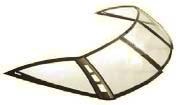
WindshieldThe Federal Circuit issued an interesting opinion today in Pacific Coast Marine Windshields Ltd. v. Malibu Boats, LLC (Case No. 2013-1199) and authored by Judge Dyk, holding for the first time that prosecution history estoppel applies to design patents and that a patentee can surrender subject matter during prosecution through its actions.

Background

The owner and CEO of Pacific Coast filed a design patent application in which he submitted drawings showing five “patentably distinct groups of designs” and claimed an “ornamental design of a marine windshield with a frame, a tapered corner post with vent holes and without said vent holes, and with a hatch andwithout said hatch, as shown and described.” The examiner issued a restriction requirement and required the applicant to elect a single group (and file additional applications for the remaining groups, if desired).

In response, the applicant chose the first designated group and amended the claim to remove the vent hole and hatch language: “the ornamental design of a marine windshield with a frame, and a pair of tapered corner posts.” He also cancelled figures 7-12, leaving just the embodiment with four circular holes on the corner post and a hatch on the front of the windshield. The remaining figures (1-6) showed alternated views of the four-hole embodiment. The amended application ultimately issued as a design patent.

Pacific Coast filed suit against Malibu Boats for making and selling windshields with three trapezoidal holes on the corner posts (shown above). Malibu Boats moved for summary judgment of non-infringement, arguing that Pacific Coast surrendered the non-four-hole embodiments on the grounds of prosecution history estoppel. The District Court agreed, and entered summary judgment in favor of Malibu Boats. Pacific Coast appealed.

The Federal Circuit Reverses and Remands

The Court first noted that while prosecution history estoppel is more often raised in the context of utility patents, the doctrine nonetheless applies to design patents. Surprisingly, this was an issue of first impression for the Court (although recognized in treatises and by district courts previously). The Court did note that the context is somewhat different, however.

For utility patents, infringement can occur either literally or under the doctrine of equivalents. Design patents are different and do not require literal identity to impose liability. Instead, liability arises if someone applies the patented design or any colorable imitation of it (in other words, sufficient similarity is sufficient). Thus, literal infringement and equivalents infringement are intertwined from the start.

The Court determined that doctrine of prosecution history estoppel should apply to design patent prosecution in order to preserve the public notice function of the process. A patentee should not be able to recapture subject matter that it abandoned during prosecution.

To determine whether prosecution history estoppel applies, the court must consider (1) whether there was a surrender of material, (2) whether it was for reasons of patentability, and (3) whether the accused design is within the scope of the surrender.

For design patents, the drawings define the scope of the invention, not the claims. Therefore, the court must look to what materials in the drawings the applicant surrendered. Here, the applicant removed drawings with two holes and no holes in the corner post. This constituted surrender of these designs and limited the design to a windshield with four holes in the corner post.

The Court next determined that the material was not surrendered for reasons of patentability—e.g., anticipation, obviousness, etc.—but it was surrendered in order to secure the patent. Pacific Coast argued that the doctrine of prosecution history estoppel only applies to surrenders to avoid the prior art, but the Court disagreed, finding the doctrine was broader than that. Any narrowing amendment made to satisfy any requirement of the Patent Act that narrows the scope of the patent qualifies. The Court concluded that amendments to satisfy a restriction requirement for design patents qualify. Notably, the Court specifically stated that it was expressing no opinion on whether this same analysis would apply to utility patents.

Finally, the Court considered whether the accused design was within the scope of the surrender. Malibu Boats argued that everything but a four-hole design was surrendered, but the Court wasn’t so sure. The patentee clearly surrendered a two-hole design and obtained coverage for a four-hole design, but did not seek coverage or surrender a three-hole design. Malibu Boats did not argue that a three-hole design was not colorably different from a two-hole design. Therefore, the Court concluded that no prosecution history estoppel arose because the surrendered material was different from the accused device (two-hole versus three-hole). The Court noted that under these procedural circumstances that it did not have to engage in an analysis of whether the scope of the surrender was to be measured by a colorable imitation standard.

Conclusion

This case presents an interesting new decision in the design patent field. Design patentees need to be careful when faced with restriction requirements, and should seriously consider filing divisional applications to avoid potential problems like these. The case also highlights the dangers of sailing in uncharted legal waters, where the Court may hold the lack of an argument against you when it may not have been clear that you needed to make it in the first place.